
CUBITAL TUNNEL SYNDROME
Dr. Cohen is well versed in non-operative and surgical care of Cubital Tunnel Syndrome.
-
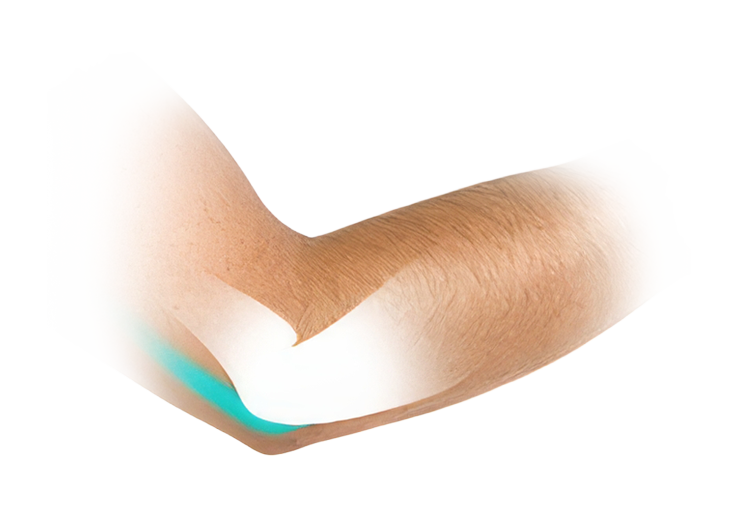
Cubital tunnel syndrome is compression of the ulnar nerve at the elbow, where the nerve passes behind the medial epicondyle - the bony bump known as the “funny bone.” It typically causes numbness and tingling in the ring and little fingers, and in more advanced cases a weakened grip. Many cases improve without surgery. Dr. Glenn D. Cohen treats cubital tunnel syndrome in Westlake Village, CA.
What Is Ulnar Nerve Compression?
The ulnar nerve is one of the three main nerves of the arm. It begins near the shoulder and travels all the way down to the hand, where it supplies feeling to the little finger and half of the ring finger and powers many of the small muscles that control fine hand movements and grip strength.
On its way to the hand, the ulnar nerve passes through two narrow tunnels: the cubital tunnel at the elbow and Guyon’s canal at the wrist. The cubital tunnel sits on the inside of the elbow, where the nerve runs behind a bony bump called the medial epicondyle - the spot most people know as the “funny bone.” At this point the nerve lies very close to both bone and skin, with little soft tissue to protect it. That is why striking your elbow there sends a sudden, shock-like sensation down into the hand.
Because the nerve is so exposed at the elbow, it is especially vulnerable to pressure. Cubital tunnel syndrome develops when the ulnar nerve is compressed, stretched, or repeatedly irritated at this site - often from leaning on the elbow or keeping it bent for long stretches, such as during sleep. Over time this can produce chronic numbness and tingling in the ring and little fingers. In more advanced cases, it can lead to a weakened grip, hand clumsiness, and difficulty with fine finger coordination.
-
Even though the ulnar nerve is compressed at the elbow, the symptoms of cubital tunnel syndrome are felt mainly in the hand. The most common complaint is numbness and tingling in the ring and little fingers - a sensation many people describe as the fingers “falling asleep.” These symptoms often come and go, and they tend to flare when the elbow is held bent for a long time.
Common symptoms include:
Numbness and tingling in the ring and little fingers
Symptoms that worsen when the elbow is bent - for example, while driving, holding a phone, or sleeping
Waking at night because the fingers feel numb
An aching or tender feeling on the inside of the elbow
A weakening grip and difficulty with a pinching motion
Clumsiness or trouble with fine movements such as typing, buttoning a shirt, or playing an instrument
Symptoms are usually most noticeable when the elbow stays bent, because bending stretches the ulnar nerve and tightens the space around it. For that reason, activities involving repeated or prolonged elbow flexion increase the risk of cubital tunnel syndrome - and many people first notice the problem because they sleep with their elbows curled.
If the condition goes untreated for an extended period, the numbness may give way to a weakening grip and difficulty pinching, as the muscles supplied by the ulnar nerve begin to lose strength. It is important to seek evaluation before the hand muscles start to waste, because once muscle wasting (atrophy) sets in, it may not be reversible - even with surgery. Symptoms that persist for more than a few weeks, or that are severe, are a good reason to be seen.
-
Cubital tunnel syndrome is usually diagnosed in the office, based on your history and a careful physical examination. Dr. Cohen will ask when and how your symptoms occur and will check the feeling in your ring and little fingers, your grip and pinch strength, and the small muscles of the hand for any sign of weakness or wasting. Two simple in-office maneuvers often help confirm the diagnosis: lightly tapping over the nerve at the elbow (Tinel’s sign), which may send a tingling or shock-like sensation into the ring and little fingers, and holding the elbow fully bent for a short period (the elbow flexion test), which can reproduce the numbness.
To pinpoint where the nerve is compressed and how severely, Dr. Cohen may order nerve conduction studies and electromyography (EMG) - tests that measure how well the ulnar nerve is carrying signals and how the muscles it controls are functioning. X-rays of the elbow may also be taken to look for arthritis, bone spurs, or the effects of an old injury that could be pressing on the nerve.
Treatment depends on the severity and duration of the nerve compression. In milder cases - numbness and tingling with little or no muscle weakness - non-surgical care is often all that is required. This may include:
Avoiding activities and positions that keep the elbow bent or put pressure on it
Padding the elbow, or wearing a brace or a night splint that keeps the elbow relatively straight during sleep
Anti-inflammatory medication to ease discomfort
Nerve gliding exercises to help the ulnar nerve move more freely
When symptoms are severe, persistent, or accompanied by muscle weakness or wasting - or when conservative measures have not relieved them - surgery may be recommended to take pressure off the ulnar nerve. Depending on the individual case, the options include releasing the tissue over the nerve at the elbow (cubital tunnel release, also called in-situ decompression), moving the nerve to the front of the elbow so it is no longer stretched when the elbow bends (ulnar nerve transposition), or removing part of the bony bump to give the nerve a smoother path (medial epicondylectomy). Dr. Cohen will discuss which approach is most appropriate for you.
As a hand and upper-extremity specialist, Dr. Glenn D. Cohen treats cubital tunnel syndrome at every stage - from conservative management to surgical decompression - at his practice in Westlake Village, CA.
PATIENT STORIES
Real patients. Real stories. Hear their experiences.
TROY
POLICE OFFICER
Cubital Tunnel Syndrome
WATCH INTERVIEW ➤
PHIL X
PROFESSIONAL MUSICIAN
Cubital Tunnel Syndrome
WATCH INTERVIEW ➤
JODY
HOMEMAKER
Cubital Tunnel Syndrome
WATCH INTERVIEW ➤
LET’S TALK
Our team is ready to deliver expert guidance and results. Let’s have a conversation about your injury or condition - and how we can help you heal.

