
HAND NUMBNESS
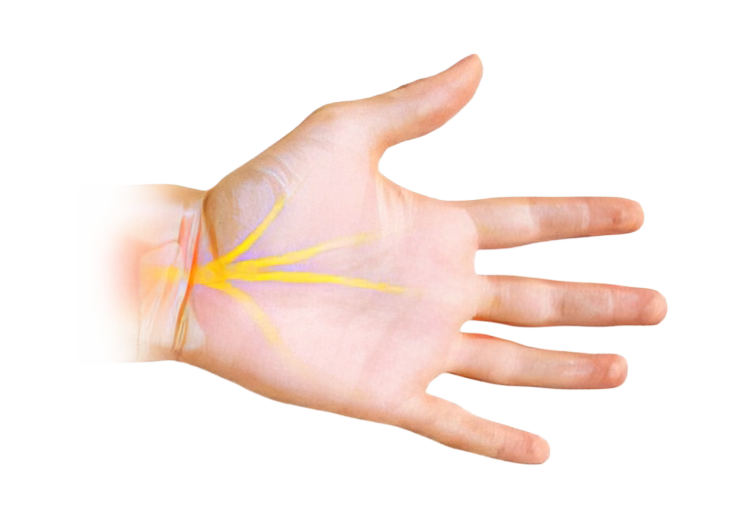
Hand numbness is a reduced or absent sense of feeling in the hand or fingers, often felt as tingling or a “pins-and-needles” sensation. It is most commonly caused by pressure on one of the nerves that travel through the arm, wrist, or hand, though conditions affecting the whole body can also be responsible. Identifying the underlying cause is essential to choosing the right treatment.
-
Numbness is a partial or complete loss of feeling in the skin. In the hand, it is frequently accompanied by tingling, a “pins-and-needles” sensation, or a feeling that the hand has “fallen asleep.” Unlike pain, which signals active irritation, numbness reflects a nerve’s reduced ability to carry sensation. Some people also notice weakness or clumsiness, while others feel only the change in sensation.
Hand numbness can affect one hand or both, and it may involve the entire hand or only certain fingers. The pattern is an important clue, because it often points to which nerve is involved and where the problem lies.
Most cases are caused by pressure on, or irritation of, one of the three main nerves that supply the hand - the median, ulnar, and radial nerves - somewhere along their path from the neck and shoulder down to the fingertips. Numbness can also originate higher up, from the nerve roots in the neck (cervical spine), or arise from conditions affecting the whole body, such as diabetes, thyroid disorders, or vitamin deficiencies. Because the possible causes range from a pinched nerve at the wrist to a systemic medical condition, a careful history and examination are needed to identify the source.
-
Hand numbness rarely occurs in isolation. Depending on the cause, it may appear alongside one or more of the following:
Reduced or absent sensation (numbness) in the hand or specific fingers
Tingling or a “pins-and-needles” sensation (paresthesia)
A burning feeling, aching, or pain that may travel up the forearm
Occasional shock-like sensations in the fingers
Weakness in the muscles of the hand or forearm, clumsiness, or a tendency to drop objects
Difficulty with fine tasks such as buttoning a shirt, typing, or handling small items
Symptoms that worsen at night or with certain positions, such as a bent wrist or elbow
The fingers that feel numb often indicate which nerve is affected.
When to seek prompt medical attention
Most hand numbness develops gradually and is not an emergency. However, sudden numbness on one side of the body - especially with face drooping, arm weakness, difficulty speaking, confusion, or trouble with vision or balance - can be a sign of a stroke and requires emergency care. Call 911 immediately. You should also be evaluated promptly if numbness follows a significant injury, comes with rapidly progressing weakness, or is accompanied by visible thinning (wasting) of the hand muscles, which can indicate longstanding nerve compression.
-
How the cause is diagnosed
Because hand numbness has many possible sources, an accurate diagnosis is the foundation of effective treatment. Evaluation typically begins with a detailed history - including which fingers are affected, when symptoms occur, and any related medical conditions - followed by a focused physical examination. Your physician may perform gentle provocative tests, such as tapping over a nerve (Tinel sign) or holding the wrist in a flexed position (Phalen test), to see whether they reproduce your symptoms.
When more information is needed, a nerve conduction study and electromyography (NCS/EMG) can measure how well the nerves and muscles are functioning and help locate the site of compression. Imaging such as ultrasound or MRI may be used when a mass, cyst, or structural problem is suspected, and blood tests may be ordered if a systemic cause - such as diabetes, thyroid disease, or a vitamin deficiency - is being considered.
Treatment options
Treatment is directed at the underlying cause. Many cases related to nerve compression improve with nonsurgical measures, which may include activity modification, ergonomic adjustments, night-time splinting or bracing to keep the wrist or elbow in a neutral position, anti-inflammatory medication, and, in selected cases, a corticosteroid injection to reduce swelling around the nerve.
When compression is severe, persistent despite conservative care, or is already causing measurable weakness or muscle wasting, a procedure to relieve pressure on the affected nerve may be recommended. When numbness stems from a body-wide condition, treatment focuses on managing that condition, often in coordination with your primary care physician or a specialist.
Because hand numbness is a symptom rather than a single diagnosis, the most effective care begins with pinpointing its cause. Related conditions evaluated and treated at our practice include carpal tunnel syndrome (median nerve), cubital tunnel syndrome and ulnar tunnel syndrome (ulnar nerve). A careful evaluation determines which is responsible and guides a treatment plan tailored to you.
PATIENT STORIES
Real patients. Real stories. Hear their experiences.

TIM
Hand Numbness, Carpal Tunnel Syndrome
WATCH INTERVIEW ➤

ROBIN
Hand Numbness
WATCH INTERVIEW ➤

CRAIG
Hand Numbness, Carpal Tunnel Syndrome
WATCH INTERVIEW ➤
LET’S TALK
Our team is ready to deliver expert guidance and results. Let’s have a conversation about your injury or condition - and how we can help you heal.

