
Trigger Finger / Trigger Thumb
Dr. Cohen has extensive experience caring for patients with trigger finger and trigger thumb, from early, intermittent catching to fingers that have become locked in place.
-
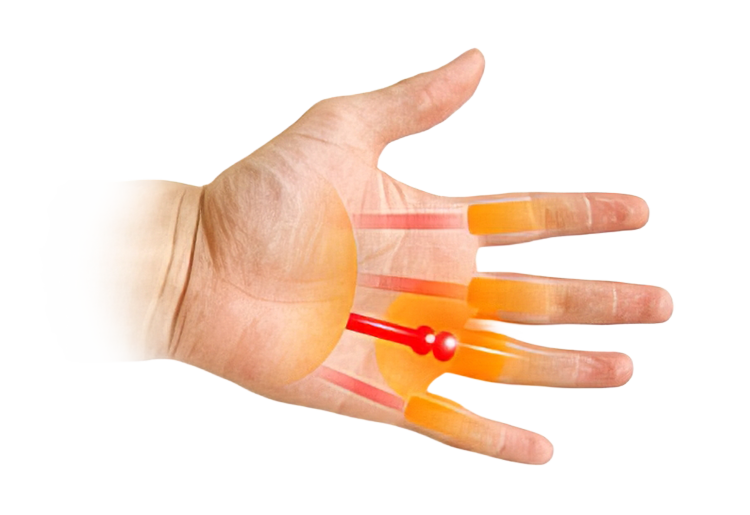
Trigger finger - called trigger thumb when it affects the thumb and known medically as stenosing tenosynovitis - is a condition in which a finger or thumb catches or locks in a bent position and then snaps straight, often painfully. It develops when the tendon that bends the finger can no longer glide smoothly through the sheath that surrounds it.
In a healthy hand, the flexor tendon slides easily through a series of snug tunnels, called sheaths, that hold it close to the bone as you open and close your fingers. With trigger finger, that tendon becomes irritated and thickened, so it no longer passes smoothly through its sheath. The sheath itself can also become inflamed and thickened, narrowing the space even further. As a result, the tendon catches for a moment when you try to straighten the finger; once it forces its way through the tight spot, the finger releases suddenly and pops straight. In more severe cases, the finger can become locked in a bent position and has to be straightened with the other hand.
The condition is linked to repetitive or forceful gripping and is more common in adults between roughly 40 and 60, in women, and in people with diabetes or rheumatoid arthritis.
-
Trigger finger symptoms usually come on gradually. In addition to difficulty straightening the affected finger, they may include:
A catching or popping sensation when you move the finger
Finger stiffness, often most noticeable in the morning
A tender lump, or nodule, in the palm at the base of the affected finger or thumb
Diagnosing and treating trigger finger early can be very beneficial, and several effective non-surgical options are available before surgery is considered.
-
Diagnosing trigger finger begins with a thorough physical examination. Dr. Cohen reviews your symptoms and examines the hand, feeling for tenderness or a nodule at the base of the finger and watching how the finger moves as it bends and straightens. In some cases, x-rays or other diagnostic tests may be used to rule out other conditions.
There are several treatment options for trigger finger, most of them non-surgical, that aim to relieve pain and restore smooth movement. The right approach depends on how severe the condition is and how long it has persisted.
Although he is well known for his surgical skill, Dr. Cohen is a firm believer in trying conservative, non-operative care before turning to surgery. For trigger finger and trigger thumb, conservative options can include:
Medication - anti-inflammatory or other medication to ease pain and swelling
Splinting - resting the finger in a splint to limit catching and triggering
Hand therapy - guided exercises to maintain motion and reduce strain on the tendon
Ergonomic modifications - adjusting how you use your hands at work and at home
Lifestyle changes - limiting repetitive or forceful gripping that aggravates the tendon
When symptoms do not respond to these measures, additional options are available. A corticosteroid (cortisone) injection placed near the tendon sheath reduces inflammation and is a common, often effective in-office treatment; it may be repeated, though it tends to work less reliably in patients with diabetes. If the finger remains locked or symptoms persist, a trigger finger release procedure opens the tight portion of the sheath so the tendon can glide freely again - typically a short outpatient procedure with a high success rate.
To discuss your symptoms and the best treatment options for you, schedule a consultation with Dr. Cohen.
PATIENT STORIES
Real patients. Real stories. Hear their experiences.

NAOMI
Trigger Thumb
WATCH INTERVIEW ➤

MS. SMITH
Dual Trigger Finger
WATCH INTERVIEW ➤

DR. LEVY
Dual Finger Trigger
WATCH INTERVIEW ➤
LET’S TALK
Our team is ready to deliver expert guidance and results. Let’s have a conversation about your injury or condition - and how we can help you heal.

